AI for predictive analytics helps analyze past data to forecast future trends, enabling better planning, decision-making, and risk management across industries.
AI for predictive analytics is a modern approach that uses advanced algorithms to study historical data and identify patterns. These patterns are then used to predict future outcomes. Over time, businesses and organizations have moved from simple data reporting to deeper analysis, and now to predictive insights powered by artificial intelligence.
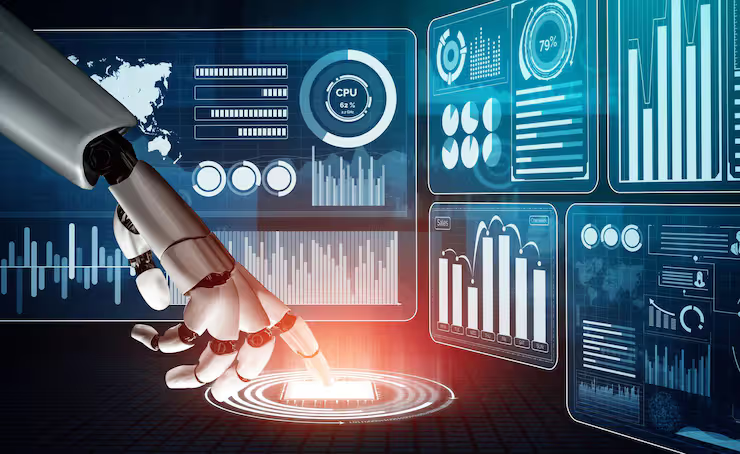
In earlier systems, data was mainly used to understand what had already happened. However, with the growth of digital technologies and increasing data volumes, there was a need for tools that could go beyond reporting. This is where predictive analytics became important. When combined with artificial intelligence, it becomes more accurate and adaptable.
AI for predictive analytics uses techniques like machine learning and statistical modeling. It can process large datasets quickly and find relationships that humans may miss. For example, predictive analytics can estimate customer behavior, detect equipment failures, or forecast demand trends.
The concept exists because modern systems generate massive amounts of data every day. Without advanced tools, it is difficult to extract useful insights from this data. AI makes it possible to turn raw data into meaningful predictions that support smarter planning.
Importance
The importance of AI for predictive analytics has grown significantly in recent years. Organizations rely on it to make better decisions, reduce uncertainty, and improve efficiency.
One of the key benefits is improved planning. Instead of reacting to events after they happen, predictive analytics allows businesses to prepare in advance. For example, companies can predict demand changes and adjust their operations accordingly.
It also helps in risk management. By analyzing past patterns, AI systems can identify potential risks before they occur. This is useful in areas like finance, healthcare, and supply chain operations, where unexpected events can have major impacts.
Another important aspect is efficiency. AI-powered systems can automate data analysis, saving time and reducing manual effort. This allows teams to focus on strategic tasks rather than routine data processing.
Predictive analytics also enhances customer understanding. By studying user behavior, organizations can anticipate needs and improve overall experiences. This is especially valuable in digital platforms where user engagement is important.
Overall, AI for predictive analytics supports smarter decisions, better resource use, and improved long-term planning.
Recent Updates
In the past year, AI for predictive analytics has seen several important developments. These updates are shaping how organizations use data for planning and decision-making.
One major trend is the use of real-time analytics. Earlier systems worked on historical data, but now many platforms can process data as it is generated. This allows faster predictions and quicker responses.
Another development is the integration of predictive analytics with cloud environments. This makes it easier to handle large datasets and scale operations without heavy infrastructure. It also improves accessibility for teams working in different locations.
Explainable AI has also gained attention. Organizations now focus on understanding how predictions are made, not just the results. This improves transparency and builds trust in AI systems.
Automation has improved as well. Modern systems can automatically update models based on new data. This reduces the need for constant manual adjustments and ensures that predictions remain accurate over time.
There has also been growth in industry-specific applications. For example, predictive analytics is now tailored for healthcare diagnostics, financial forecasting, and manufacturing processes.
These updates show that predictive analytics is becoming more advanced, accessible, and reliable.
Laws or Policies
As AI for predictive analytics becomes more widely used, governments and regulatory bodies have introduced policies to ensure responsible use.
Data privacy is one of the most important areas. Regulations require organizations to protect personal data and use it responsibly. This includes obtaining consent and ensuring secure storage of information.
Another key aspect is transparency. Some policies encourage or require organizations to explain how AI models make decisions. This helps users understand the reasoning behind predictions.
In certain regions, there are guidelines for ethical AI use. These guidelines focus on fairness, accountability, and avoiding bias in predictive models. Ensuring that AI systems do not discriminate is an important part of these policies.
Data governance frameworks are also important. They define how data should be collected, stored, and processed. Proper governance ensures data quality and reliability, which directly affects prediction accuracy.
In India, digital data protection frameworks emphasize user privacy and responsible data handling. Organizations using predictive analytics must follow these rules to ensure compliance.
Overall, laws and policies aim to balance innovation with responsibility, ensuring that AI technologies are used safely and ethically.
Tools and Resources
To work effectively with AI for predictive analytics, various tools and resources are commonly used. These tools help in data collection, processing, analysis, and model building.
Data visualization tools are important for presenting insights clearly. They help users understand patterns and trends through charts and dashboards.
Machine learning frameworks provide the foundation for building predictive models. These frameworks allow users to train algorithms on historical data and generate predictions.
Data management platforms are used to store and organize large datasets. Proper data management ensures that information is accurate and easily accessible.
Statistical analysis tools help in identifying relationships between variables. These tools support the development of predictive models by providing insights into data patterns.
There are also automated analytics platforms that simplify the process. These platforms can generate predictions with minimal manual input, making them suitable for users with limited technical knowledge.
Learning resources such as online courses, documentation, and tutorials are widely available. These resources help individuals understand how predictive analytics works and how to apply it effectively.
Using the right combination of tools and resources can significantly improve the effectiveness of predictive analytics systems.
FAQs
What is AI for predictive analytics?
AI for predictive analytics uses artificial intelligence to analyze historical data and predict future outcomes. It helps organizations make informed decisions based on data-driven insights.
How does predictive analytics improve planning?
Predictive analytics identifies patterns and trends in data. This allows organizations to anticipate future events and plan accordingly, reducing uncertainty and improving efficiency.
What industries use predictive analytics?
Predictive analytics is used in many industries, including healthcare, finance, manufacturing, retail, and logistics. It supports tasks like forecasting, risk analysis, and performance improvement.
Is predictive analytics accurate?
The accuracy depends on data quality and model design. With proper data and advanced algorithms, predictive analytics can provide highly reliable insights.
What skills are needed to use predictive analytics?
Basic understanding of data analysis, statistics, and machine learning is helpful. However, modern tools also make it accessible to users with limited technical knowledge.
Conclusion
AI for predictive analytics has become an essential part of modern data-driven systems. It transforms raw data into meaningful insights that support better planning and decision-making. By analyzing past trends and predicting future outcomes, it helps organizations stay prepared and efficient.
The growing importance of predictive analytics reflects the increasing role of data in everyday operations. Recent advancements, such as real-time analytics and explainable AI, have made these systems more reliable and accessible.
At the same time, laws and policies ensure that predictive analytics is used responsibly. Data privacy, transparency, and ethical considerations play a key role in building trust in AI systems.
With the right tools and resources, predictive analytics can be applied across various industries. It offers a practical way to improve planning, reduce risks, and enhance overall performance.
As technology continues to evolve, AI for predictive analytics will likely become even more powerful, helping individuals and organizations make smarter, data-driven decisions.